
What Is the Cobalt Orbital Diagram?
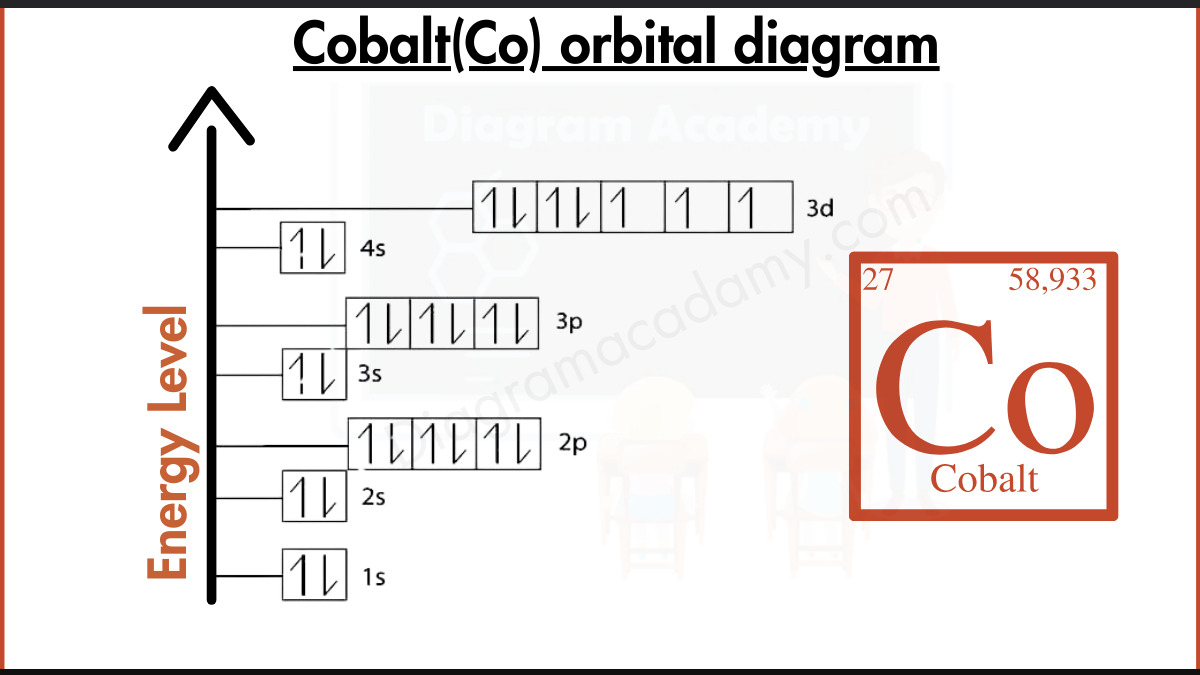
The cobalt orbital diagram is a visual representation that shows how electrons are arranged in the atomic orbitals of a cobalt atom. Instead of listing electrons in text form, the orbital diagram cobalt uses boxes and arrows to clearly display orbital occupancy and electron spin, making it ideal for diagram-based learning.
What Atomic Information Is Needed for the Orbital Diagram for Cobalt?
To understand the orbital diagram for cobalt, basic atomic details are required. Cobalt has the symbol Co and an atomic number of 27, meaning it contains 27 electrons. It is a period-4, d-block element, which explains the importance of d orbitals in the cobalt orbital structure.
How Does Electron Configuration Define the Cobalt Orbital Diagram?
The electron configuration of cobalt is:
1s² 2s² 2p⁶ 3s² 3p⁶ 4s² 3d⁷
This configuration directly determines how electrons are placed in the orbital diagram of cobalt, converting each orbital into boxes filled with arrows.
How Is the Orbital Diagram of Cobalt Filled Step by Step?
In the orbital diagram of cobalt, electrons fill orbitals from lower to higher energy following the Aufbau principle. The 4s orbital fills before the 3d orbitals. Within the 3d subshell, electrons occupy separate orbitals before pairing, a key feature clearly shown in the orbital diagram for cobalt.
What Does the Cobalt Energy Level Diagram Show?
The cobalt energy level diagram arranges orbitals vertically to represent increasing energy. Lower-energy orbitals appear at the bottom, while the 3d orbitals are shown higher. This layout helps viewers visually understand orbital energy order at a glance.
What Is Orbital Notation for Cobalt?
Orbital notation for cobalt uses arrows to represent electron spin in each orbital. In cobalt, several electrons remain unpaired in the 3d orbitals, which explains its magnetic behavior. This is clearly visible in cobalt orbital notation diagrams.
Why Is the Orbital Diagram for Cobalt Important?
The orbital diagram for cobalt is essential for understanding bonding, oxidation states, and magnetic properties. It is widely used in chemistry education, exams, and digital diagram libraries.
Frequently Asked FAQs
Here are the answer to common question about Orbital diagram of Cobalt (Co).